Sunday, January 10, 2016

Suspension: Miata Modification

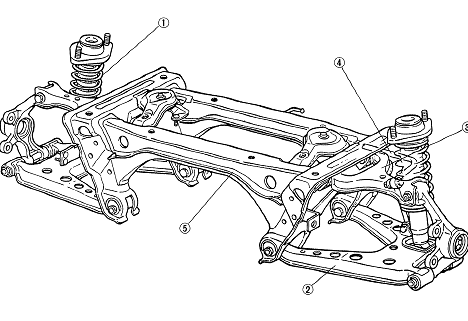
First Saturday work day of IAP for the MechE team!  Plenty of new work to do now that we have the new parts.  We're hoping that the Miata suspension geometry provides an adaptable platform and valuable reference for developing our independent Opel suspension.


Colonel CAD Alberto was at it immediately, focusing on generating Solidworks models for the Miata subframe structure, and then the control arms and knuckle.


Alex and Z went to town on battery duty, starting to work with the subframe structure team to design the battery support structure in the rear of the car.  We hope to be integrating the battery mounting CAD into the rear subframe models soon.  


Ryan and Olivia are working on mounting the Miata/Suspension+Motor+Transmission subframe into the Opel frame.  Testing is taking place on the old rear half of the white Opel that we still have in the back room.  


It is still unclear if we will need to cut away the wheelwell/frame in any places in order to allow clearance for the upper control arm in the new independent suspension layout.  The previous design with the straight axle had no problems, but Ryan and Olivia cleared out some space with the angle grinder so that we could take the necessary measurements.


The goal is to get rid of the white Opel shell in the very near future.  The solidworks models are coming together, and we hope to have an integrated subframe prototype sometime next week.


Saturday, January 9, 2016

MechE Junkyard trip! New Suspension Strategy

After some thought and research, we're going to design our suspension and drivetrain system around the miata rear wheel drive subframe assembly.  The size and shape made it a good option for incorporating into the Opel, so we decided we would just hunt down an old rear assembly for reference to get us started.

Friday night we had an informal meeting with some new members to talk suspension over dinner.  We talked through some general suspension info and theory, and the plans moving forward.  


With the new plans, we wanted to get the necessary parts in time for the Saturday work day meeting, so we were up at sunrise and took the truck out hunting.  GAW Used Auto Parts in Walpole turned out to be a gold mine, with acres of cars to dig through.


There was a huge section of classic cars, and we even managed to find a couple of Opels!


There were a couple miatas to choose from, and we managed to unearth a rear suspension subframe.  Everything except the set of lower control arms.  It was in slightly rough shape, but definitely fine for modeling the geometry and fitting it to the Opel.


Nothing but fun dragging it back across the lot through the mud!


It was still early in the morning, and we made it back with plenty of time before the EVT meeting.  Time to tear it down and clean it up!

Monday, December 28, 2015

New Motorcycle Plans


Following the long-awaited return of former EVT legend, Lennon Rodgers, the team has a revived interest in the electric motorcycle scene!  Lennon led the team’s efforts at the Isle of Man TTZero race back in 2011, where EVT’s converted BMW bike received the best time out of all the first year teams.


As an additional project to go along with the Opel conversion, the team has started working on a motorcycle that will compete in the Pikes Peak hill climb event.  The Pikes Peak event will have significantly less demanding energy requirements than the Isle of Man race, making it a good initial goal for getting started with electric motorcycles again.  The winning electric bike actually outperformed the gas powered bikes at last year’s race:


The project has been headed by Jimmy (sophomore) as the Motorcycle Team Lead, along with Lennon’s mentorship.  Lennon, Jimmy, and the motorcycle team has decided that modifying a commercially-available Zero bike would be the most feasible option for getting started with the motorcycles again.  A list of potential modifications for modifying the bike focused on the improved cooling and thermal considerations, better aerodynamics, and improved controls.  Alterations to the suspension and upgrading the wheels were also under consideration.   


There were a few delays before finally bringing in a bike, but Lennon was able to help us acquire the new 2016 model Zero FXS.  Earlier work throughout the semester focused on developing Matlab simulations and modeling for the race in order to confirm that this would indeed be the best platform for modification.


While we still haven’t decided whether or not we will be preparing this bike in time for the upcoming 200th Anniversary race this June, we can finally get to work now that we have the bike in the shop in time for IAP! 
Zero FXS in the Milkdrop!

Saturday, November 21, 2015

Gloucester Clean Energy Fair 2015, Porsche Appearance!

The 1976 Porsche 914EV recently made an appearance at Gloucester's TownGreen2025 Clean Energy Fair! Read more about the event here.

A handful of team members made the trek out to the event, where we got to display our Porsche as well as the electric ATV alongside the new BMW electric i3!


The Porsche was featured prominently right at the entrance to the Gloucester High School.  As people from the community entered the building to see both exhibits of research projects and vendors for green businesses at the event, we were able to tell them about the Porsche, our current Opel conversion project, and the work we do as a team.


We also had a great opportunity to check out the new BMW models!


The day's events made for an awesome team bonding experience, and it was great to see how well-received our vehicles were at the event.  The newer team members had a chance to learn a lot of info about the Porsche project as well.  We taught them the controls and made time for some driving lessons through the parking lot as we were clearing out!


Wednesday, October 14, 2015

Update - 10/10/15

Week five of the new EVT semester!


On the MechE side, the Suspension Subteam continues to work at redesigning the Opel's suspension. 

Suspension Design 101 with Jimmy Handy 
The team is reworking the subframe holding the suspension and powertrain components:

"The old design for the subframe used non-right angles to make it smaller, however, especially in the prototyping phase, mitered angles are more difficult to cut than straight across." - Jacob Fisher

Powertrain subframe assembly


The EE subteams are also making headway on their projects.

Several new EE's have finished schematic capture for the CAN dev board and are currently finalizing PCB layout.

Others are working on a wheel velocity sensor that will transmit to subscribing modules on the CAN bus.


Stay tuned for more updates! 

Saturday, October 3, 2015

Update - 10/03/15

Lot's of progress being made by the Opel sub teams! 

Here are some of the things members did this week:
  • Installed and began learning KiCad
  • Began schematic capture for CAN dev board 
  • Characterized hub motors for voltage, frequency parameters
  • Took measurements of stepper motor dimensions for PCB footprints 
  • Installed and began learning SolidWorks
  • Began mockup of front compartment and cooling system
  • Set up firmware and hardware templates for electrical subsystems
  • Learned about CAN communications
  • Got two LPC uControllers talking to each other over CAN bus


Saturday, September 12, 2015

First meeting of 2015


A new year, a new batch of awesome freshman, and a lot of work to be done!

On the electrical side, the team is focusing its efforts on the development of several key components of the car architecture: driver interface, user interface, motor interface, throttle interface, low voltage system, gauges, and wheel velocity sensor. 

Alison (gauges):
"My group went through a small tutorial to introduce [freshman] to CAN - the communication protocol we'll be using in the Opel. Some of the topics we covered to get to this point included:

  • Microcontrollers
  •  How CAN works at the physical level
  • How CAN works at the software level
  • Sending messages over CAN
  • Checking if messages received over CAN contain specific data
  • General C syntax
  • Bitwise operations

Ultimately, we were able to get two microcontrollers (LPCLLCX4?) talking to each other over CAN, and sending each other messages that caused an LED to turn on or off. In the future, members will apply what they learned to focus on a specific component on the CAN bus - the user interface.”

Skanda (driver interface):
"Our group started to flesh out the design for the electrical subsystem that accepts driver inputs (e.g. turning on headlights, blinkers, windshield wipers, etc.). We worked with our new members to make sure they understood the subsystem's basic architecture (switches -> LPC controller -> vehicle CAN bus and peripheral relays). After that, we took a look at Hugo's specs and decided on some of the relays that we should use, and the driver interface casing. We also thought about how to fit in our goal of having different car performance settings (sporty and non-sporty, with different throttle profiles). We indicate on the bus (with designated non-conflicting CAN ID x800) which setting our car currently is set to, after which the throttle subsystem should adjust its output accordingly."

Joey (batteries):
"Battery sub-team introduced perspective new members to the design considerations we are facing with weatherproofing the front cabin, cooling the batteries, and mounting the batteries. We came up with some preliminary solutions for the weatherproofing of the cabin and cooling the batteries. Next steps are to test the preliminary solution we came up with, and to research more about air flow to determine if there is a more optimal method of both cooling and waterproofing."

In addition to the Opel conversion, the team is kicking off a new motorcycle project, headed by Jimmy Handy, for the Pikes Peak competition:

“We are currently working on creating some Matlab simulations that will allow us to choose the model of Zero that is the best starting point for us. We are looking at the initial cost of the bike, energy requirements for each of the bikes to complete the race, weight, and acceleration profiles. 
The current winner is the zero FX. This is zeros lightest and cheapest bike. We plan on switching the motor and controller from the fastest, heaviest, and most expensive zero to the lighter bike in hopes we can have the best of both worlds.”