Friday, June 13, 2014

Trailer Brakes Update

We've been plugging away on the emergency brakes for the trailer for a while now, finally putting up the pics!  Eric and Rango on the Electrical Engineering team worked through all of the electronics for actuating the brakes a while ago, leaving them just to be mounted.

We stuck with the car window motors after being unable to find a solenoid or other alternative that could offer the amount of power that we needed.  Their worm gear drive makes them very powerful, as well as being unable to be backdriven, which is a helpful feature for pulling the brake cable.  One downside to using them was just that they had very irregular shapes, which made them slightly inconvenient to mount.  The position of the motors below the trailer also caused orienting them to require a lot of consideration so that there was still sufficient clearance with the ground.  We also didn't have symmetric models, meaning that we needed to have separate mounting plates for each side.   


I started mocking up some mount ideas by just laser cutting some crazy shapes out of MDF to find an optimal way of fitting them up under the trailer.  As with the suspension and everything else we've attached to the trailer in the past, I mounted it by compressing it between plates and squeezing it up against the trailer frame as opposed to drilling directly into it.


I tried to make the mounting plates fit the angle of the angle iron that attached the rim brakes.  I ended up going with a 3 plate sandwich sort of setup in which I made the back plate holding the angle iron larger, and compressing the trailer frame box tube between that and a second plate to which the motor was attached, and then squeezing the motor between that second plate and a smaller third plate.  The only problem was that because of the asymmetry, I could only fit 2 hex bolts through all 3 mounting plates on the right side as opposed to 4 on the left, but it seems like the 2 fewer bolts does not sacrifice the structural integrity of the mount.  Here's what the final waterjetted aluminum plate configurations looked like:


Left Side Brake Motor


Right Side Brake Motor

The EE team had steadily pushed forward through all of the work with controlling the motors, and you can see the plans of the custom electronics for the brakes in a November blog post.  Here is a video of Rango demonstrating the firmware.


The only major problem once the brakes were mounted was that they were drawing too much current, which was solved by just adding another DC to DC converter to power them.


Weatherproofing/Paint:

Although we didn't use the brakes on our way to Providence, they were securely mounted for the duration of the trip.  The mounting held up fine, but the elements did a number on the exposed steel surfaces of the angle iron mounting plates and parts of the motor.  A much needed cleaning and spraying with the rust restore, primer, and black spray paint cleaned everything up pretty nicely, and now the black finish matches the black bar over the wheels on the trailer.


Monday, June 9, 2014

Summer Kickoff!

After a successful display at Commencement, we were ready to get back to work in the lab on the trike project.  We're hoping to finish up the last bit of work and plan out the trip to New York soon.  Saturday was our first meeting for the summer, and it looks like we're in good shape!

This summer is shaping up to be a very exciting and busy EVT season.  Jacob and I (Jarrod) are the two full full-time UROPs for the team, and a number of other members are around the area and helping out for the summer.  We have a lot of different projects going on, but the priority is still getting the trike ready for New York.  Here're some updates:

Weatherproofing: 

We're still plugging away on our wooden picture frame style cage to encase the trailer.  Erich modified the front panel so that if fit around the fixture we mounted to run the necessary wires from the trailer up to the trike.  Now we just need to finish priming, painting, and mounting the plastic within the panels.


We also wanted a slight curve in the top panel, so that we could avoid any potential issues with water puddling up on the top in the case of rain.  Jacob went ahead and ordered some PETG for the walls since it is flexible and could be easily heated and formed if we needed to bend it.  At 1/16" thick, the sheet is also slightly thicker than the clear pvc sheet that we were going to use, and hopefully more durable.  


I ended up just laser cutting a couple ribs that mounted directly to the top panel of the frame and give us the contour that we wanted.  Initially, the plastic sheet fits in decently, with some minor bending at the sides where we might end up bending the plastic.  Hopefully we are nearing the completion of the final waterproofing stage of the trike.


RUST:

So we finally had to go back and correct the rusting problem that we were experiencing on the steel trailer brake mounts and the surrounding hardware:


The mud and salt from the wet roads on the Providence trip did a number on the exposed steel angle iron and motor mount, and had just been setting up until this point.  We finally took everything back apart, sanded down the pieces, and sprayed it with rust reformer, a couple coats of primer, and black paint to try to minimize the rusting on the New York trip.


Other Considerations:

Hanna also started looking into using Xbees so that we could wirelessly transmit the data from the Cycle Analyst to a laptop on the chase vehicle so that we can keep up with the condition of the trike throughout the duration of the trip.  We also discussed trying to get radio equipment in the helmet of the rider so that we can communicate much more easily on the road.

We also started to briefly look into planning the trip to New York.  Ideally, we want to plan it much more carefully than the Providence trip, so as to eliminate some of the unnecessary stops that we needed to make.  We also considered whether we want to make the trip multiple days, or just continuously drive the entire distance with multiple drivers rotating.  At over 20 hours, it would definitely be a long trip, but many of us felt that a trip from Boston to New York is not quite as exciting of a story if it takes us all week to get there, and we want to show that our trike is durable enough and capable of working through the sustained demand of 200+ miles in 20 hours. If we do attempt the 20 straight hours, then we do need to work out the logistics of traveling at night as well, and install lights and plan accordingly.  We've got a lot more to plan out, so we will hopefully be making these decisions soon.


Saturday, June 7, 2014

Graduation


We presented some of our electric vehicles at the MIT Commencement yesterday as part of the Mechanical Engineering Showcase.  Big congrats to all of our graduating members!


It was a fun day and everyone had a really good time.  We brought down the Porsche, the Trike/Trailer combo, and Roberto's new EV Cholocycle.  Harry also brought his normal motorcycle for contrast, and Charles displayed his new Chibi-Mikuvan.  We got to present and talk about our work with a number of alumni, students, and parents who were at the event, and it was great seeing that so many people interested in our work. 


Sunday, March 23, 2014

Test Run to Providence!

The Team at Brown University
The team took another big step toward the New York trip with our milestone test run to Providence last weekend!  In just over 5 hours of travel, Mark Jeunnette rode the trike/trailer combo all the way from the N52 shop to Brown University in Providence, Rhode Island!


We prepared for the big trip with some important testing and fine tuning the week before.  We made some final adjustments and tested out the running trike/trailer combination through the halls of the IDC.  This successfully proved that all of the controls were working properly...and that the trike was indeed faster and handled better than the mobility scooter.  


After we made sure that all of the equipment indeed fit inside of Erich's truck, Mark got to take the trike out for some more road testing as well to make sure that all of the systems and regen were working properly.  The trike held up well after a long set of laps through the parking lot, although we eventually encountered a problem in which the contactors would not remain closed.  Although it seemed alarming, the problem was quickly identified as a bad connection and corrected back in the shop.  Overall it was a very productive day of testing.


The Big Day


The Crew at N52 before departure
 March 15 was the big day, and we were all ready to go, planning to get everything packed and ready to go at 6am and on the road by 7 so that we could be out of the city before traffic got too hectic.  The weather didn't quite cooperate though, and some light rain in the early morning delayed our departure.  Fortunately it wasn't enough to cancel the trip, and gave us all a chance to head up to Harvard for a quick IHOP breakfast as a team before loading up the truck.  


 After getting situated in the N52 parking lot, we were good to go! Mark drove the trike with Erich and Alex rolling in the pickup truck, and I drove the minivan with Roberto, Joey, Jacob, and Eric.  We followed directly behind the trike to watch out over Mark, and Erich left later with the truck.  The roads were a little bit slick to begin, but we made it out of MIT just fine, with everyone on the sidewalks pointing and cheering for Mark as he drove by.


After about an hour of driving, we stopped at Stonybrook Plaza in Roslindale to check in and tighten up some screws and grab some snacks while we were there.  Roberto made sure to point out and take a picture of the notorious telephone pole that we hit with the truck when attempting the Providence trip last year.  This spot in Dedham was the farthest Lennon made it on the ebike before the hub motor burned up:


The trike was handling well and making great time, although we had to make a quick, unplanned stop when one of the flags flew off and Roberto had to go running after it. 


Mark also had to pull over just before noon after encountering a problem with the throttle.  It proved to be minor, and was fine once the controller was reset.  Yet, when we opened up the fairing, we noticed another problem in that the wheels were kicking up all the dirt, mud, and salt into the fiberglass enclosure and making a mess of the inside of the trailer.  We quickly cleaned off the dirt from the electronics as best as we could and temporarily solved the problem by covering the trailer with rags and tshirts inside of the fairing.


We were quickly back on the road and back to passing people who were just riding normal bicycles, until we hit another snag just after we crossed into Rhode Island at 1:15 and were stopped by the cops.  With the minivan following the trike at 20 mph, we started really backing up traffic when we reached narrow roads.  The policeman definitely had some questions about the trike and what we were doing with it, as well as safety concerns.  After a brief conversation, we were all set to continue the voyage, but with both the truck and the van leading the trike and periodically waiting up for Mark.


At 2:30 we finally reached Providence, and headed over to Brown to meet up with Roberto's cousin and some of our friends who attend school there.  It was an exciting 5 hours of travel, and the trike held up well as it rolled on in to the Brown campus.   


After some burgers, milkshakes, and a tour around the campus, it was time to pack it all up into the truck and head back to Cambridge.  It was a fun and exciting trip, but none of us had the energy or enough sun left in the day to ride the trike back over to MIT.  The few extra unplanned stops pushed the trip just over 5 hours and ended up being 51.84 miles, in which we used 30% of our battery pack.  It was definitely a successful adventure, although at that rate it'll be cutting it close trying to go the entire 200+ miles to New York City.  We've got some refinement and work left to do, but we're hoping to make the necessary adjustments and embark on the New York trip soon!


Saturday, March 22, 2014

Porsche: Inspection

Ahh...the beginning of Spring Break here at MIT. Only about half of the regulars were here, but it made it much easier to get a concentrated project completed. With the new plates in hand, Joey and Jacob took over putting on the new plates while I stuck my head below the dashboard to try to figure out which wires were headed from the washer switch to the front compartment. Roberto went in search of tubing and taking care of the fittings for the water side of the windshield washer.

We traced the wires to the front of the vehicle, and not surprisingly to the windshield wiper motor. There was only one and it was connected to each wiper with a 4-bar linkage.
The electrical connections for the wiper motor. I thought there would be fewer wires.


The washer pump went in easily enough, but we had to improvise on the washer reservoir. The reservoir we purchased would have required extra fittings, and we were running out of time; so we used a water bottle and went off to the inspection station. As we drove, I wonder how far we had come from the previous group which used a pressurized bottle for the reservoir.


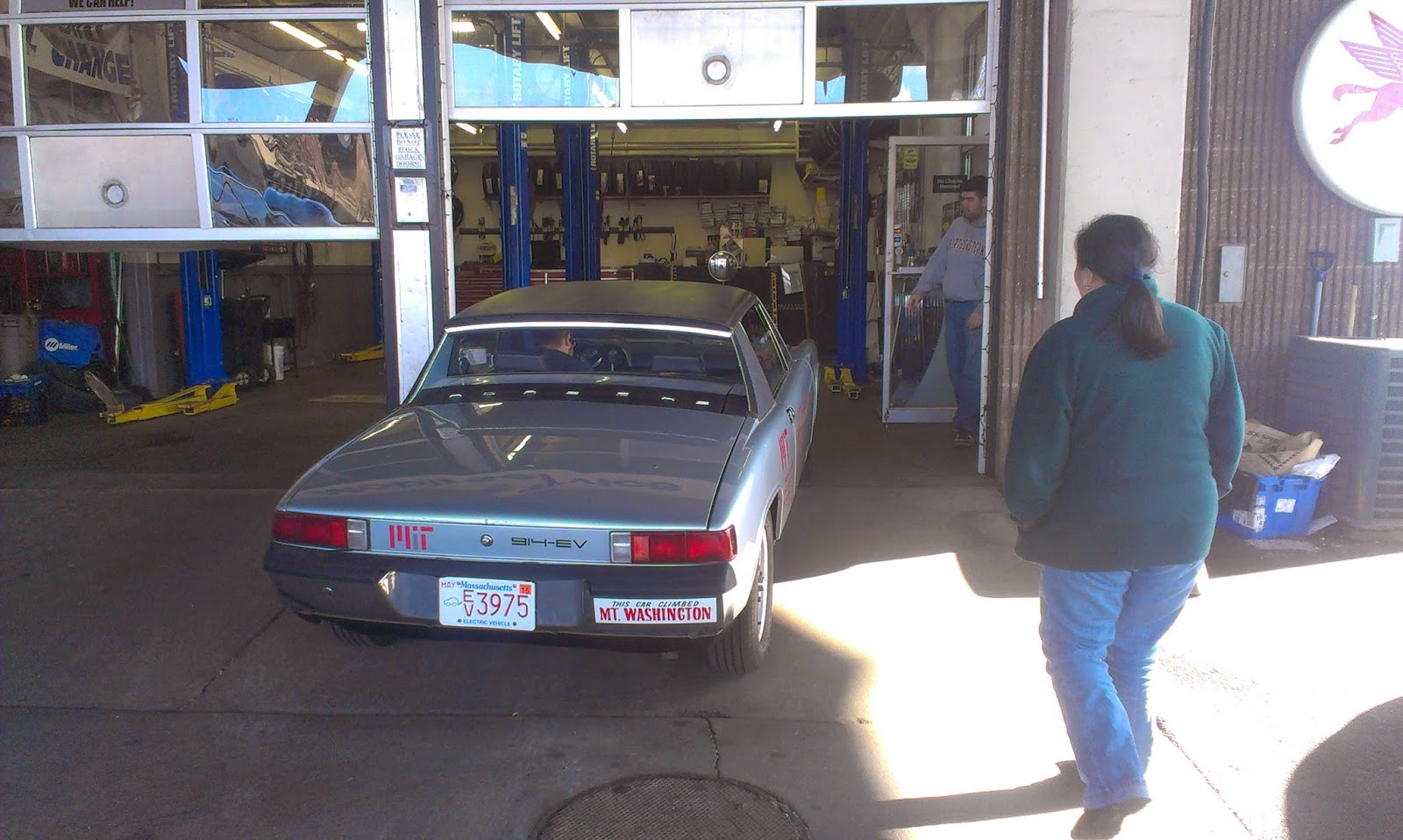
Into the inspection station. Note the EV license plate.
As we got to the inspection station, we failed almost immediately. Something happened between the time I shut down the vehicle in the parking spot, and turning it back on a few minutes later. The horn, signals, lights, and windshield wipers didn't work at all. It was like they weren't getting power. Heads hung low, we drove back to the shop and started brainstorming what happened.

After 45 minutes, we decided to check the low voltage fuses, and found one that was most definitely blown. I posted in July about fuses, and I should have recognized the symptoms earlier. I still don't know why there were so many systems drawing from that one fuse.
Most definitely blown, but an easy fix.
After changing the fuse, we set off again. Since the inspection station wanted the last car to be in by 5 pm, and closed at 6 pm; we were able to fit in at 5:20 since we were there earlier.

This time we passed, with the only closing note being that we should change our wiper blades since the blades were smearing rather than clearing.

On the way back to the shop, we stopped and I asked a good friend (Kaitlin) if she could take a picture since we were the only three still around the shop at the time. Michelle (in the background) is an alum who helps to provide some sanity to all the nutty things that Roberto and I dream up.

Success!

With the title, registration, and inspection in hand, this process began with a thought in June 2013 and work began in July 2013. I can't thank the team enough for keeping me going to press through with getting this process done. The Mechanical Engineering department gave us some much needed help to help us climb Mt. Washington in September 2013, and that experience helped us to build the camaraderie and team skills we needed to make progress through the fall and to this point. Last but certainly not least, I would like to thank Sandra Lipnoski from the Edgerton Center, for helping me through the administrative process, and always reminding me to make copies of important documents.

Monday, March 17, 2014

Porsche: Title and Registration

Since my Finance Theory class was cancelled today, I went to the RMV (Registry of Motor Vehicles) in Chinatown and took care of getting the title and registration for the Porsche. I walking into the RMV at 1:30, and walked out at 5:20. If anyone wants to find a good place for a coffee shop, it is right next to the RMV. Compared to being at MIT, the boredom of sitting at the RMV waiting for hours to be called was excruciating. Alternatively, a recumbent bike attached to a small generator might do wonders for giving folks an outlet and giving kids and antsy college kids something to do.

As always, a smile can go a long way, and I walked out of the RMV with two EV plates in my backpack, and a copy of the interim title/registration. The catch was simply that I had to have to vehicle inspected within 7 days time. No pressure of course.

Saturday, March 1, 2014

Porsche: Windshield Washer

The signals work, we have the title in hand, and the car runs well; however, we still can't pass inspection. The car was shipped from the factory with the windshield washer driving off a pressurized system. To fit the batteries into our Porsche, the spare tire was removed, as was the original windshield reservoir system.

In the past, this obstacle was overcome with a pressurized soda bottle that utilized the same switch from the original car. However, Roberto and I both were not keen on maintaining this system for the future. Our rationale was simple; water and electricity don't mix well, especially high voltage.

To satisfy the requirements for inspection, I followed two different set of directions to build an understanding of what to expect. Since I relied on them heavily in the initial phases, I don't mind posting the links here. However, I should note that not all of the information was completely accurate for our vehicle. I am unsure if this applies to all 1976 Porsche 914s, or just ours, since it has been heavily modified from the stock setup.

PelicanParts Tech Article
ElectroClassic EV

To start off getting down to the wiper switch unit itself, I followed the two links and removed the horn assembly, and steering wheel.

Getting closer to the windshield switch. I drew the line on the column there to help with reassembly later. The copper lines and surface seen around the column there is part of the turn signal assembly.

Here is the mount for the steering wheel, note the 6 (six) smaller screws that would match the six hex head bolts of the steering wheel. There was a matching mark on the mount to help with alignment later.
I didn't take any more pictures, but the after-market replacement unit was simple enough to fit in without having to shave down or adjust the male end of the plug as the posted website instructions had mentioned.